
We recently presented at the GeoIT Symposium in Berlin on 16 March 2026 with a talk about Open RTLS, indoor mapping, and the practical layers missing from many location-system stacks. The live presentation is public at open-rtls-geoit.pages.dev , and the source for it is in the public Open-RTLS GeoIT Symposium repository .
What matters to us is not just that we gave the talk. It is how we produced it. Instead of building the deck slide by slide by hand, we used AI to generate a sophisticated Reveal.js presentation with a clear story, strong pacing, and a slick design language that matched the subject matter. The result felt much closer to a small product launch than to a traditional last-minute slide deck.
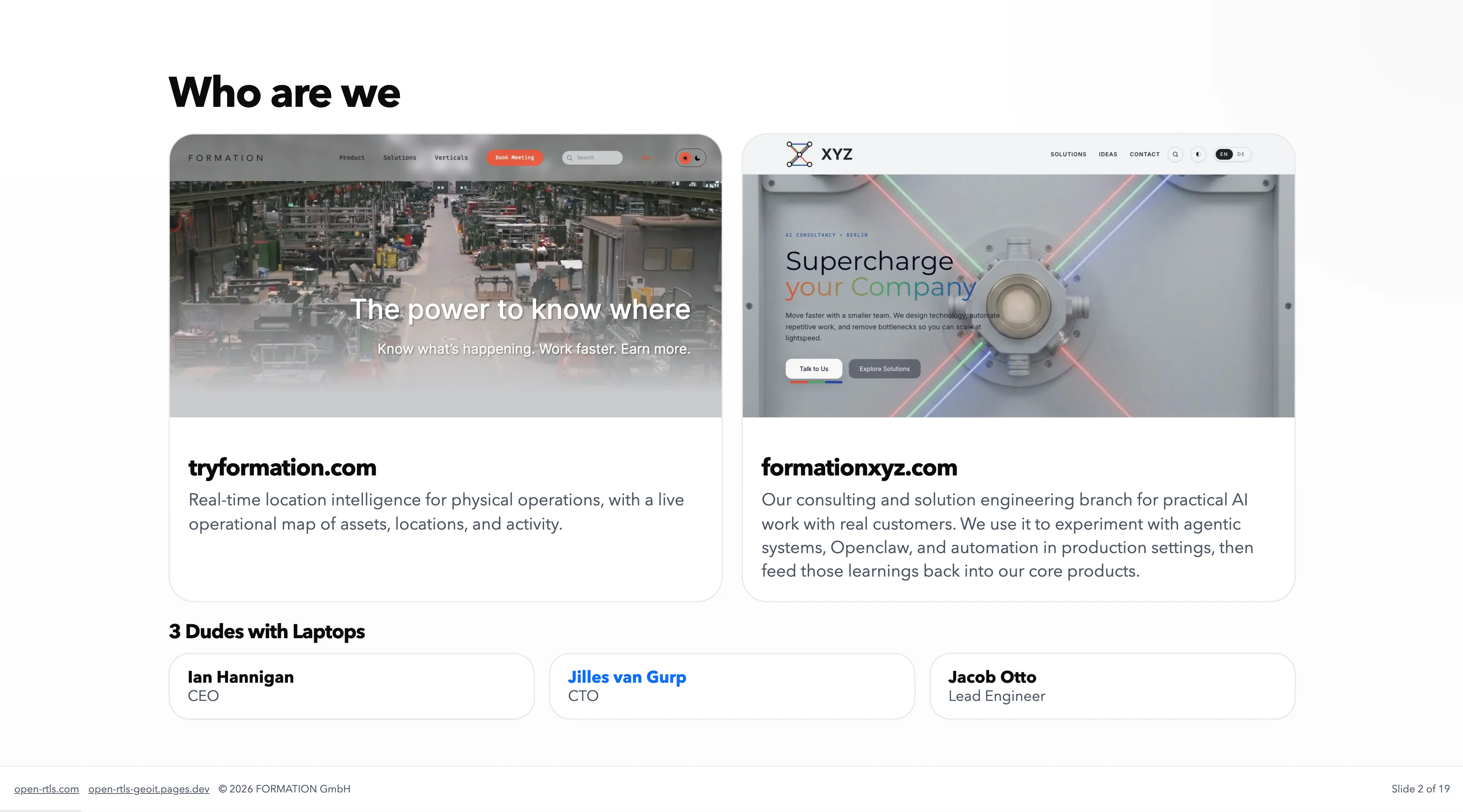
Because the deck lived in a repo instead of in a slide editor, the AI could work on real project artifacts: slides.md, the presentation CSS, SVG visuals, screenshots, deployment config, and support scripts. That changes the quality of what you can get. You are no longer asking an assistant to guess what good slides might look like. You are giving it a structured workspace where it can actually build and refine the presentation as a working system.
The design quality came from that setup. The deck was built in Reveal.js, styled as a lightweight branded site, and published to Cloudflare Pages. That meant we could iterate quickly on layout, hierarchy, images, QR codes, and pacing, while still keeping the output easy to host, easy to share, and easy to version. Public delivery matters here, because a presentation should not disappear after the room empties. It should become a reusable asset.
The other important part was . We used repo-local skills to control what the AI was allowed and expected to do. For example, the deck maintenance skill told the model which files mattered, which narrative to preserve, what visual direction to keep, and what not to overcomplicate. That sounds simple, but it is a big operational difference. Without skills, you get a capable model with a lot of freedom. With skills, you get a more disciplined collaborator that understands the intended workflow and stays inside the rails.
In practice, that meant the AI could help with presentation writing without drifting into generic filler. It knew the deck should stay mapping-first, keep the Open RTLS story concise, avoid unnecessary runtime complexity, and preserve the established visual language. The same mechanism is useful well beyond presentations. Skills are one of the cleanest ways to turn an AI from a broad assistant into a reusable team process.
One detail we particularly liked was how we handled PDF export. Reveal.js has print options, but they do not always preserve the exact on-screen result, especially when you have runtime fitting, layout tuning, and slide-level polish that is designed for the viewport. So we improvised a separate export skill for PDF generation. Instead of relying on print mode, the skill starts a local preview server, opens the deck in a headless browser, captures each slide as a screenshot, and then stitches those screenshots into a one-page-per-slide PDF. That is a practical engineering workaround, and it is exactly the kind of small but high-leverage tool AI is good at helping create.
This is the broader point. AI is not only useful for writing text inside slides. It is useful for building the whole presentation pipeline: structure, copy, design, visuals, deployment, and export. Once the work happens in a repo with the right constraints, creating a high-quality presentation becomes much closer to shipping software than dragging boxes around in a presentation tool.
There is also a compounding effect. Once presentation work moves into a workflow like this, you can steadily enforce consistent visuals, consistent language, and reusable structure across decks. Each new presentation can start from the patterns, components, and phrasing that already worked in earlier ones. And if a deck needs refinement, you can iterate in a very direct way: give the AI screenshots of the current version and explain what feels off, or provide screenshots of source material you want it to work from. That turns presentation design into an iterative operating process instead of a fresh manual effort every time.
If that sounds appealing, explore the live deck at open-rtls-geoit.pages.dev and the source repo at github.com/Open-RTLS/geoit-symposium-march26 . Interested in using AI to never make presentations manually again? Talk to us .